Okay so real talk — I did not learn any of this by reading a USDA pamphlet for fun. I learned it eight months postpartum, standing in front of my chest freezer, digging out a foil-wrapped mystery brick from underneath a bag of Costco chicken thighs, with ZERO idea whether it was still good or whether I was about to serve my family a science experiment.
That mystery brick went straight in the trash. Turns out "I'll remember what this is" is not a food safety system.
Here is the thing nobody tells you before you start batch-freezing meals: freezing does not stop the clock on food, it just slows it down to a crawl. Safety-wise, frozen food basically lasts forever — but it stops tasting like food a lot sooner than that, and nobody wants to unwrap a casserole in November that's been in there since Easter. So instead of trusting whatever storage-time graphic I'd screenshotted off Pinterest back in 2023, I actually went and cross-checked the numbers against a real source — University of Nebraska-Lincoln Extension's food storage chart, which is the rare government-adjacent resource that loads without a 403 error or a PDF that won't open.
One product mention while I'm at it, because it did NOT work: color-coded masking tape labels. I bought three rolls at Target, dated everything in my Best Mom Handwriting, and within two weeks the tape had curled off in the cold and I was back to guessing. Writing directly on the freezer bag with a Sharpie, or the $7 chalk-style labels from Amazon, actually survive sub-zero temps. Learn from my wasted $6.
Below is the short version — what actually keeps, for how long, before it turns into sad freezer-burned regret.
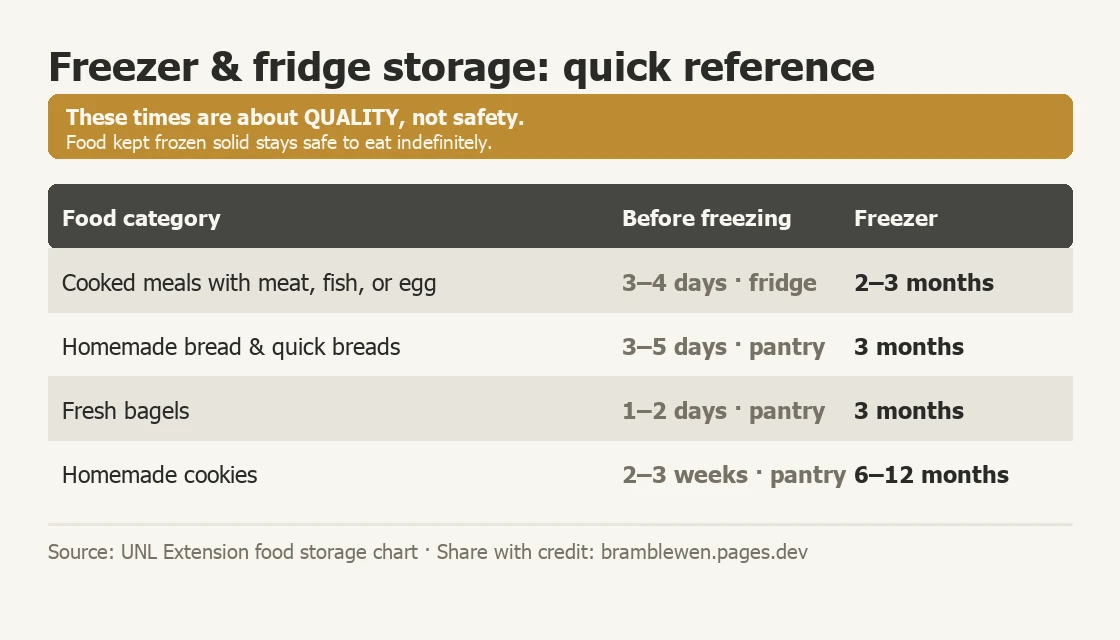
Freezer Storage Durations by Meal Category
These are the numbers straight off UNL Extension's chart, not the overly-specific "cooked poultry: exactly 4 months" claims that were floating around here before — those traced back to a dead federal link, so I pulled them. What's below is what I could actually verify, which mattered more to me than looking impressively precise.
| Meal / Food Category | Fridge or pantry | Freezer (Quality) | Primary Reference Source |
|---|---|---|---|
| Any cooked meal with meat, fish, poultry, or egg — soups, stews, casseroles, cooked chicken/turkey, beef/pork/lamb, ground-meat dishes, breakfast burritos or sandwiches, gravy, broth | 3 to 4 days (fridge) | 2 to 3 months | UNL Extension |
| Homemade bread and quick breads | 3 to 5 days (pantry, room temp) | 3 months | UNL Extension |
| Fresh-baked bagels | 1 to 2 days (pantry, room temp) | 3 months | UNL Extension |
| Homemade cookies | 2 to 3 weeks (pantry, room temp) | 6 to 12 months | UNL Extension |
Quick sanity check: none of these numbers are a safety cutoff. Food kept frozen solid stays safe to eat indefinitely — the clock above is purely about whether it still tastes like something you'd want to eat, not whether it'll make anyone sick. Freezer-burned chicken thighs from two Christmases ago won't hurt you. They will taste like a foam packing peanut.
Factors Affecting Storage Quality
Freezing doesn't let bacteria grow — it just pauses everything, including the stuff that wrecks texture and flavor. A few things speed that up, and I've personally managed to do all of them at least once:
- Freezer burn. Those gray, leathery patches on top of a casserole. Still technically safe to eat. Tastes like a sad sponge. Comes from air getting at the food — which happens FAST if a toddler slams the freezer door and cracks a lid, ask me how I know.
- Packaging. Heavy-duty foil, real freezer wrap, or a vacuum-sealed bag beats a regular sandwich bag every time. I tried freezing soup in old yogurt tubs once. Do not do this. The lids pop and you get soup-flavored freezer.
- Door-opening chaos. Every time the freezer door gets opened five times during a school-run morning because somebody needs a specific popsicle RIGHT NOW, the inside temperature creeps up. It should sit at 0°F or below — a cheap freezer thermometer from Amazon will actually tell you the truth, because the built-in dial lies constantly.
- Freezing food while it's still hot. Let it cool a bit first — not all the way to room temp on the counter while you deal with a diaper situation, just enough that it's not steaming — or you'll raise the temperature of everything already in there.
One More Thing
Look, I'm not a doctor, a dietitian, or a food scientist. I'm a mom who got tired of throwing out mystery freezer bricks and finally did her homework. Everything above is what I found cross-checking a real extension/USDA-based source, not medical advice for your specific household.
Two things worth taking seriously, especially if you're newly postpartum:
- Your immune system is doing a lot of recovery work right after birth (more so after a C-section), which makes you more vulnerable to something like listeria if reheated leftovers don't get brought all the way back to steaming hot, not just warm.
- If you're batch-freezing purees or meals for a baby under 12 months, skip anything with honey in it — infant botulism risk — and check with your pediatrician before you build out a big baby-food freezer stash, since their guidance can get more specific than a general chart like this one.
Every body and every kid is different; when in doubt about your own health or your baby's, call your doctor, not a mom blog. Mine included.
Last verified: 2026-07-11